Utilization rate
Billable hours logged against available hours, per person or per team, for any period you choose.

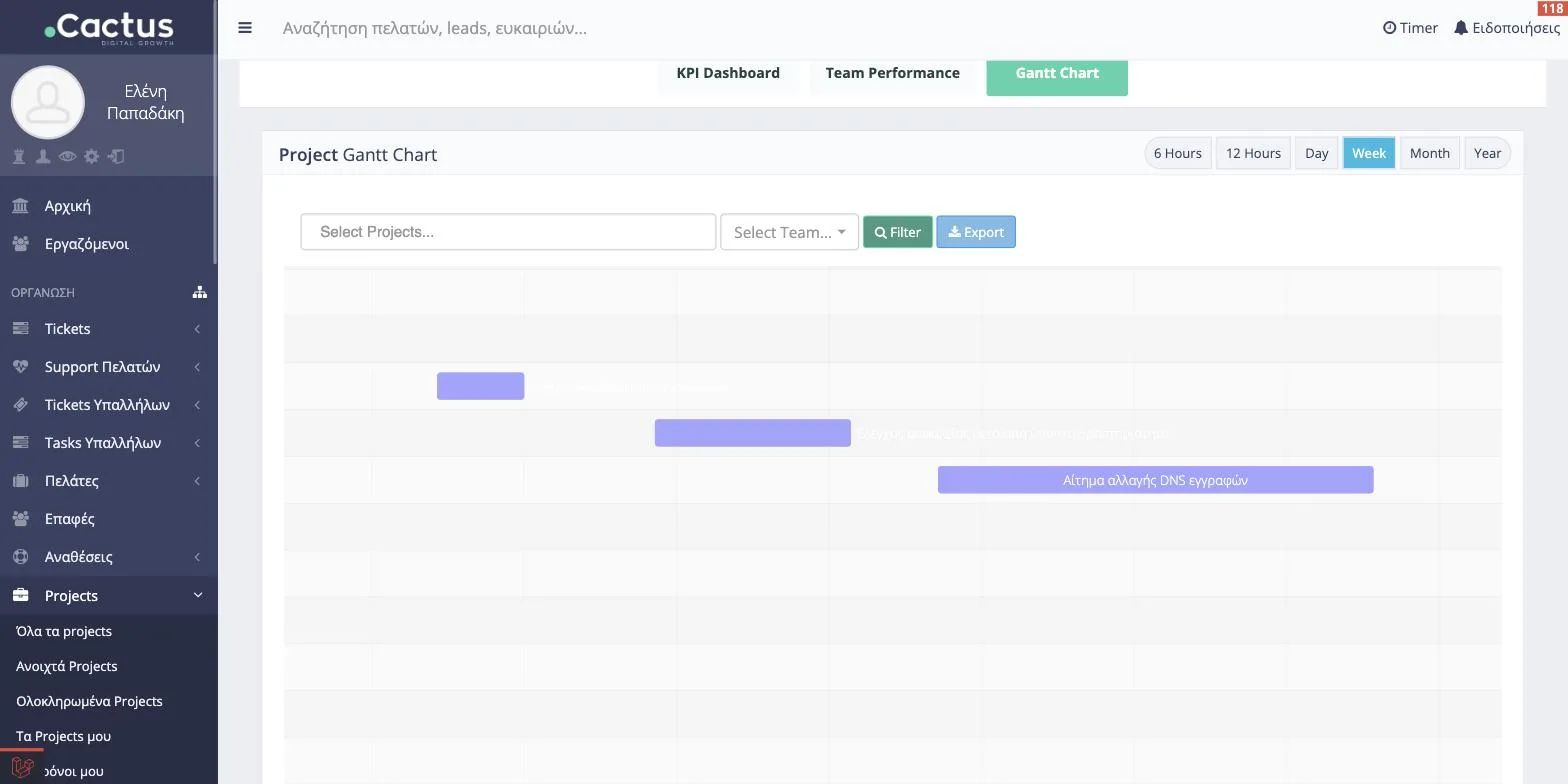
Gantt, team assignments, deadlines and time logged per project, on the same platform as the client, their tickets and their invoices, not in a separate project management tool.
Every phase change is recorded with a date, so material-gathering time, development time and total duration are calculated automatically, not just the day the project was delivered.
The contract is signed and the project clock starts.
Collecting copy, images and details from the client.
The brief is complete and the team can start.
Active work on the project, with time logged per assignment.
The client sees the result and comments on it.
The project closes and moves into the invoicing flow.
A development project doesn’t look like a design project, and the system tells them apart from the start.
Type (examples)
Design
Status
Priority
Every project has a budget. The system compares that budget with the cost of the time actually logged on the project (its own time plus the time of the tickets that belong to it) and works out the margin that is left, with no spreadsheet kept on the side.
Before you say “yes” to a new project, the question isn’t only whether the team wants it. It’s whether it fits. Three numbers answer that, without opening a separate spreadsheet.
Billable hours logged against available hours, per person or per team, for any period you choose.
Available versus already committed hours per team over the next four weeks, so you know whether a new project fits before you take it on.
Billable hours times the team’s hourly rate: what the team earns in money, not just in hours.
Every active project has a schedule status calculated from its real data, not from a manager’s hunch.
A manager can also try out scenarios: with this many people and this many hours a day, when does the project finish? The tool calculates an estimated date from the hours remaining. Useful for “what if we added a person?”, not a delivery guarantee.
A PDF of time per client goes out filtered by period, billable or not, and employee, ready to send or file, without rebuilding it in a spreadsheet every time. Internally, a weekly report compares expected with actual hours per person, properly subtracting leave and Greek public holidays, so an employee on leave doesn’t look as if they skipped work, and so a team lead sees only their own team, not the whole company.
Yes. A project’s cost is calculated from its own time AND the time of every ticket that belongs to it, not only the time logged directly on the project.
Every active project has a schedule status calculated automatically from the hours estimated against the hours actually logged, not from someone’s gut feeling.
No. It is an estimate based on a simple rule of hours per active project: useful for telling whether a team can fit new work, not a guarantee of a specific date.
30 minutes. We show you the platform, listen to how your team works, and send a tailored proposal within a few days.